Why First Principles Thinking Drives Breakthrough Innovation: What the World’s Most Innovative Companies Do Differently


In a world where industries evolve faster than strategies can keep up, many organizations fall into a familiar trap: they innovate by analogy.
They look at what competitors are doing and try to do it slightly better.
But the most transformative companies do something different.
They start from first principles.
First-principles thinking is a method that traces its roots to the ancient Greek philosopher Aristotle, who described first principles as the fundamental truths from which knowledge is derived. Instead of assuming the current way of doing things is correct, first principles thinkers break problems down to their most basic components and rebuild solutions from the ground up.
Today, companies like Tesla, Amazon, Toyota, and Apple have used this approach to create new markets, redefine industries, and build enormous competitive advantage.
But what exactly are they doing differently?
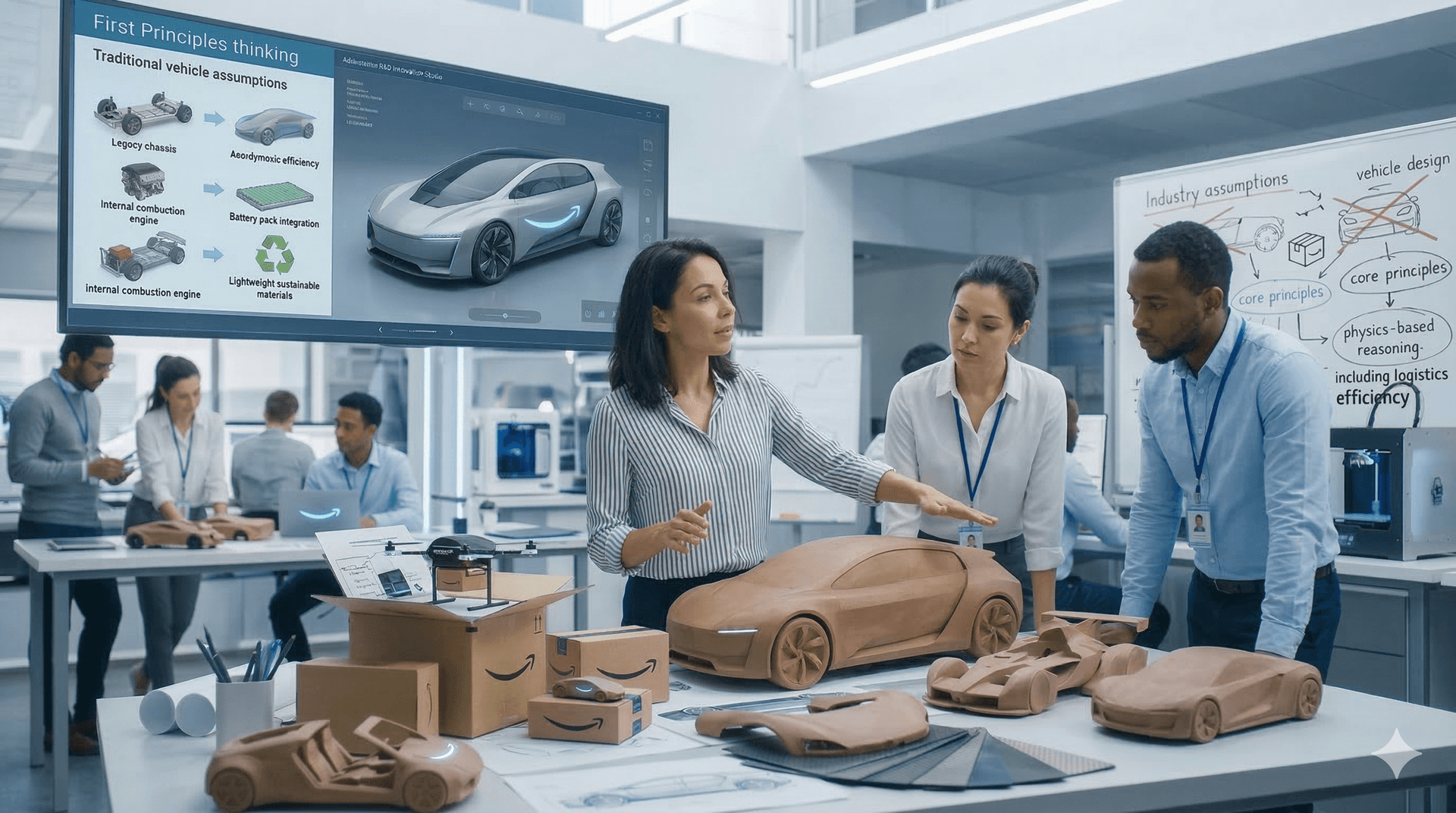
What First Principles Thinking Looks Like in Practice
When you examine organizations that successfully apply first principles thinking, a pattern emerges. These companies consistently follow three core practices.
1. They Challenge Industry Assumptions
Most industries operate on a set of inherited assumptions.
- Cars must be powered by internal combustion engines
- Retail requires physical stores
- Furniture must be expensive to be well-designed
First principles thinkers challenge these assumptions.
Tesla asked a simple but powerful question:
What is the true cost structure of an electric vehicle?
Instead of accepting the prevailing wisdom that electric cars would always be expensive, Tesla broke down the components of battery production, manufacturing, and supply chains. This led to the creation of Gigafactories and vertically integrated battery production.
The result was not just an electric car.
It was the redefinition of the automotive industry.
2. They Reduce Complex Problems to Fundamental Truths
Companies that use first principles thinking simplify complexity by identifying what is fundamentally true.
Toyota did this when developing the Toyota Production System.
Instead of copying Western mass production, Toyota asked:
What actually creates value for the customer?
The answer revealed that much of traditional manufacturing was wasteful: excess inventory, unnecessary movement, waiting time, and defects.
By eliminating waste and designing production systems around value creation, Toyota invented what we now call lean manufacturing, a methodology that has reshaped industries worldwide.
3. They Rebuild Systems from the Ground Up
Once the fundamental truths are identified, first principles thinkers rebuild systems around them.
Amazon provides one of the clearest examples.
Jeff Bezos famously framed Amazon’s strategy around a few immutable truths:
Customers always want:
- Lower prices
- Faster delivery
- Greater selection
From these principles, Amazon built entirely new systems:
- A global logistics network
- The Prime membership ecosystem
- The AWS cloud infrastructure
These innovations weren’t incremental improvements to retail.
They were structural reinventions of commerce.

Common Practices Among First Principles Organizations
Across industries, from technology and manufacturing to consumer goods, organizations that successfully apply first principles thinking share several common behaviours.
They Focus on Root Causes
Instead of solving surface-level problems, they ask:
- Why does this problem exist?
- What constraints are real versus inherited?
This often reveals that many industry limitations are simply conventions.
They Use Interdisciplinary Thinking
First principles thinking often draws insights from multiple disciplines.
Tesla combines physics, engineering, manufacturing, and software.
Apple blends design, psychology, and engineering.
This cross-disciplinary perspective allows organizations to see solutions others miss.
They Encourage Experimentation
Once fundamental insights are identified, organizations must test new ideas rapidly.
Companies like Amazon and SpaceX embrace experimentation because they know the path to breakthrough innovation is iterative.
Experimentation converts theory into reality.

The Results of First Principles Thinking
Organizations that consistently apply first principles thinking tend to achieve three powerful outcomes.
1. Breakthrough Innovation
Rather than incremental improvement, first principles thinking enables category-defining innovation.
Examples include:
- Tesla redefining electric mobility
- Airbnb transforming hospitality
- Netflix reinventing entertainment distribution
2. Structural Competitive Advantage
Because these companies build systems from the ground up, they often create capabilities competitors struggle to replicate.
- Amazon’s logistics network.
- Toyota’s production system.
- Apple’s integrated ecosystem.
These advantages compound over time.
3. Long-Term Strategic Clarity
First principles thinking provides a clear strategic foundation.
Instead of reacting to trends, organizations anchor their strategy around enduring truths about customers, technology, and value creation.
This allows them to adapt more confidently to changing environments.

Why This Matters More Than Ever
Today’s organizations operate in an environment defined by rapid technological change, shifting customer expectations, and increasing complexity.
In such conditions, relying on analogy or incremental improvement is rarely enough.
First principles thinking offers something more powerful:
A way to cut through complexity, uncover fundamental truths, and build solutions that redefine industries.
The companies that master this approach don’t just respond to change.
They shape the future.

A Discipline for Every Organization
First principles thinking is not reserved for visionary entrepreneurs or Silicon Valley startups.
It is a discipline that any organization can cultivate.
It begins with a simple question:
What do we know to be fundamentally true?
From there, everything becomes possible.
If this thinking resonates, the CoCr8 OS is the framework behind it — available as a live decision tool, a consulting engagement, or a free starting point.
Try the Decision Spark Canvas, explore the CoCr8 Innovation Hub, or start a conversation.