Beyond Ideas: How the Evolution of Crowd Psychology Explains Innovation Adoption


Innovation doesn’t fail in the lab.
It fails in the crowd.
That idea remains unchanged. But what’s often missing is the depth to which this pattern is rooted in history.
When we step back and look at the evolution of crowd psychology, a clearer picture emerges:
Innovation has never been purely technical.
It has always been socially transmitted, and that transmission follows patterns we can now understand and design for.
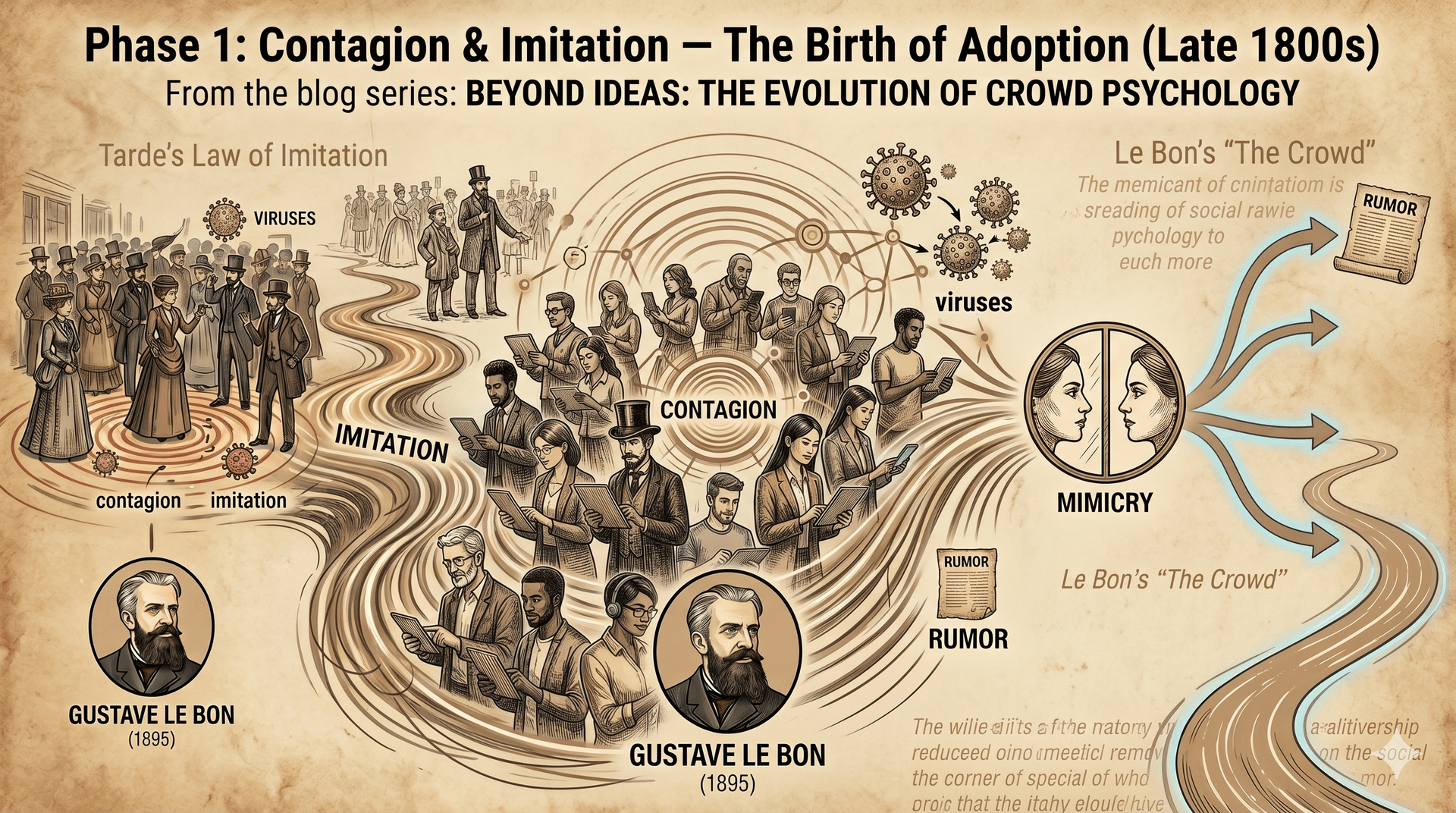
Phase 1: Contagion & Imitation — The Birth of Adoption (Late 1800s)
The earliest thinkers in crowd psychology, Gustave Le Bon and Gabriel Tarde, weren’t studying innovation, but they inadvertently explained it.
Le Bon introduced the idea of contagion:
- emotions and behaviours spread through groups like viruses
Tarde introduced something even more important:
-Imitation is the mechanism of social change
His insight was simple but profound:
Society evolves not through invention alone…but through people copying each other.
Implication for leaders:
Innovation adoption has never been about superiority.
It has always been about visibility and mimicry.
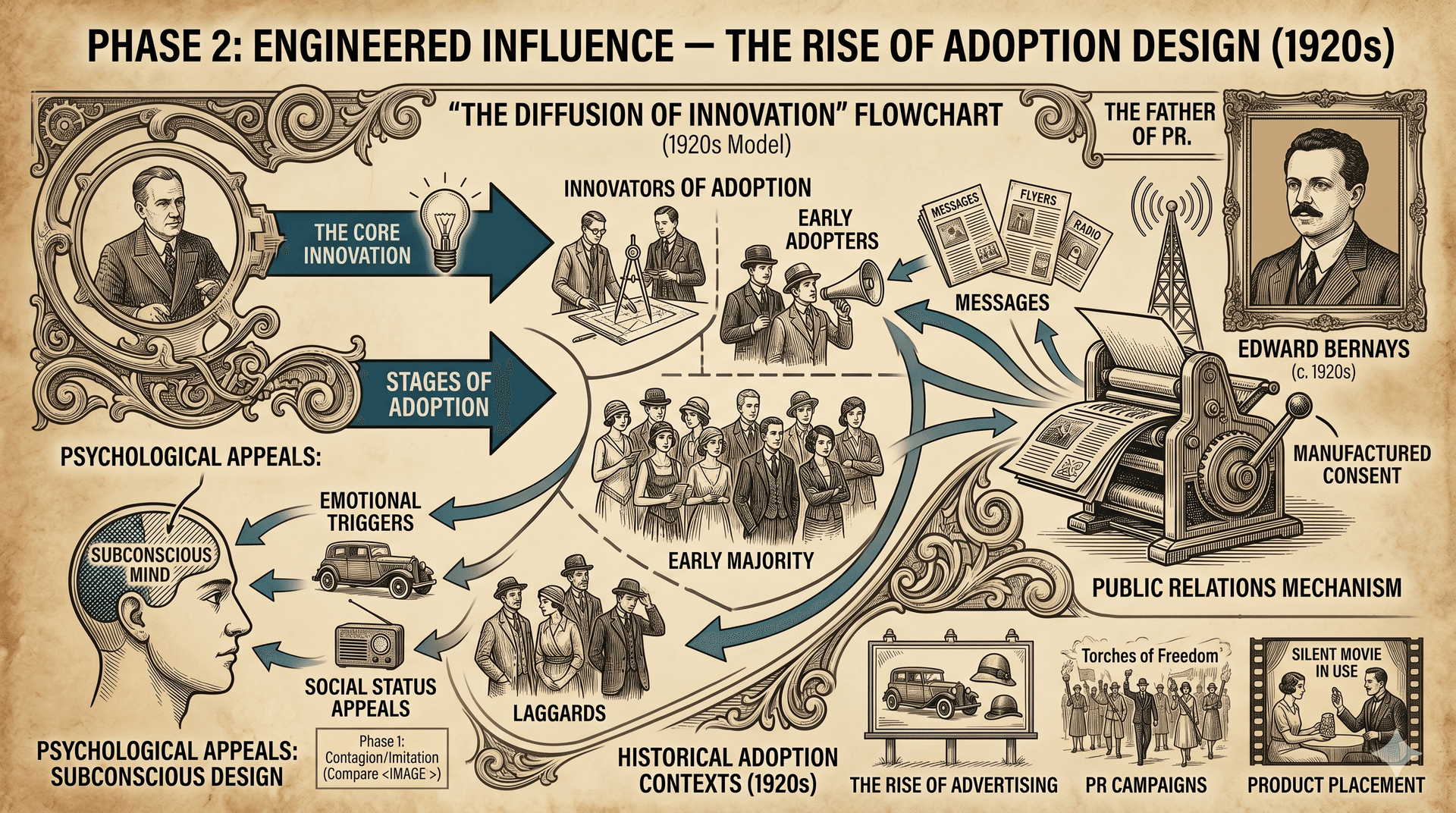
Phase 2: Engineered Influence — The Rise of Adoption Design (1920s)
With Sigmund Freud and Edward Bernays, crowd psychology moved from observation to application.
Bernays proved something that still defines modern marketing:
- People don’t adopt products for what they do
- They adopt them for what they mean
He introduced the concept of engineered consent, linking products to identity, emotion, and aspiration.
This was the birth of:
- branding
- public relations
- symbolic value
Implication for leaders:
Adoption is not functional.
It is psychological and symbolic.
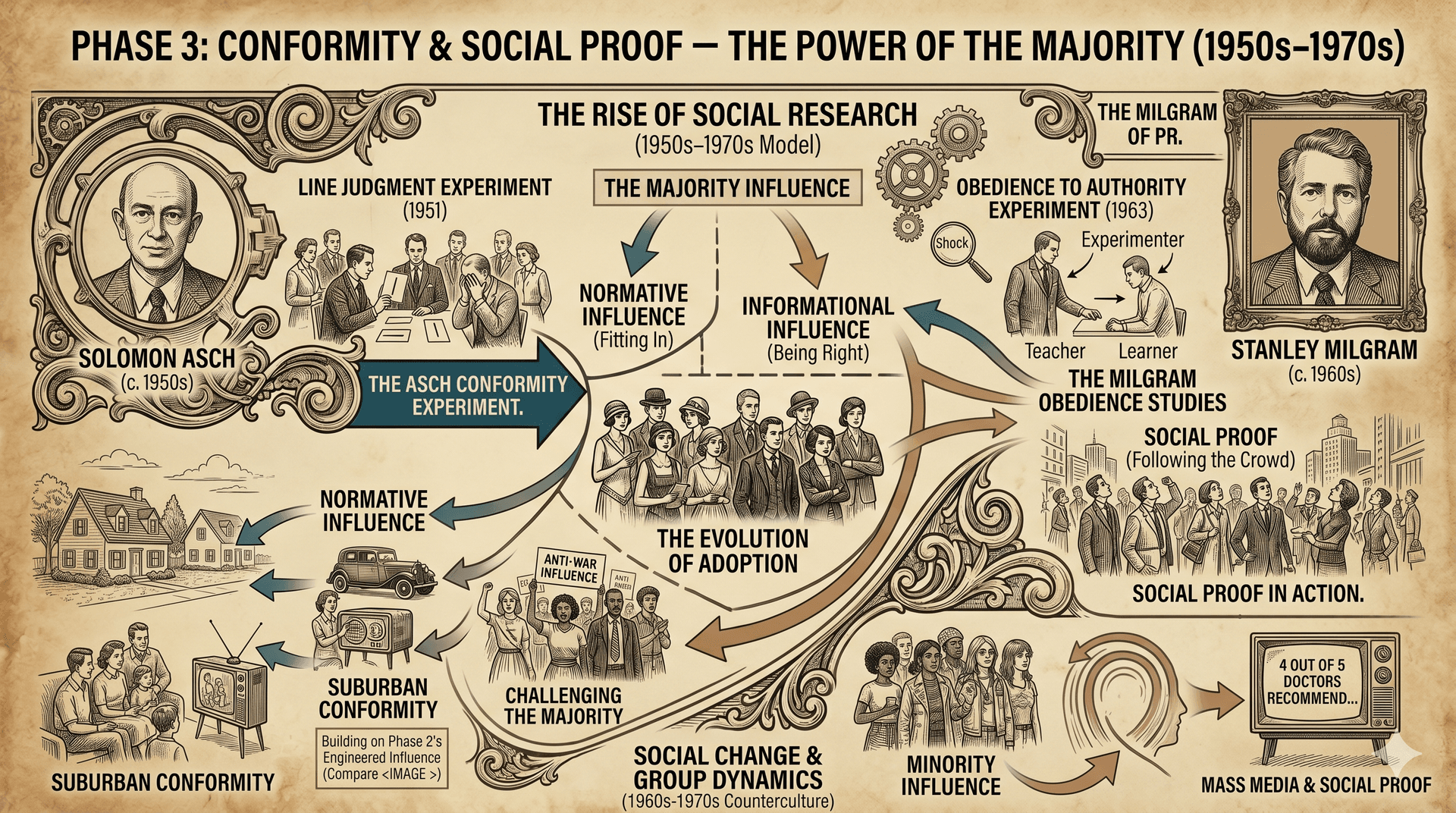
Phase 3: Conformity & Social Proof — The Power of the Majority (1950s–1970s)
Experiments by Solomon Asch and Stanley Milgram revealed something uncomfortable:
People will abandon their own judgment to align with the group.
Even when the group is wrong.
This introduced two critical forces:
- social proof
- authority validation
Implication for leaders:
Technically superior innovation will fail if the crowd hasn’t validated it yet.
Adoption requires:
- visible momentum
- trusted advocates
- perceived consensus
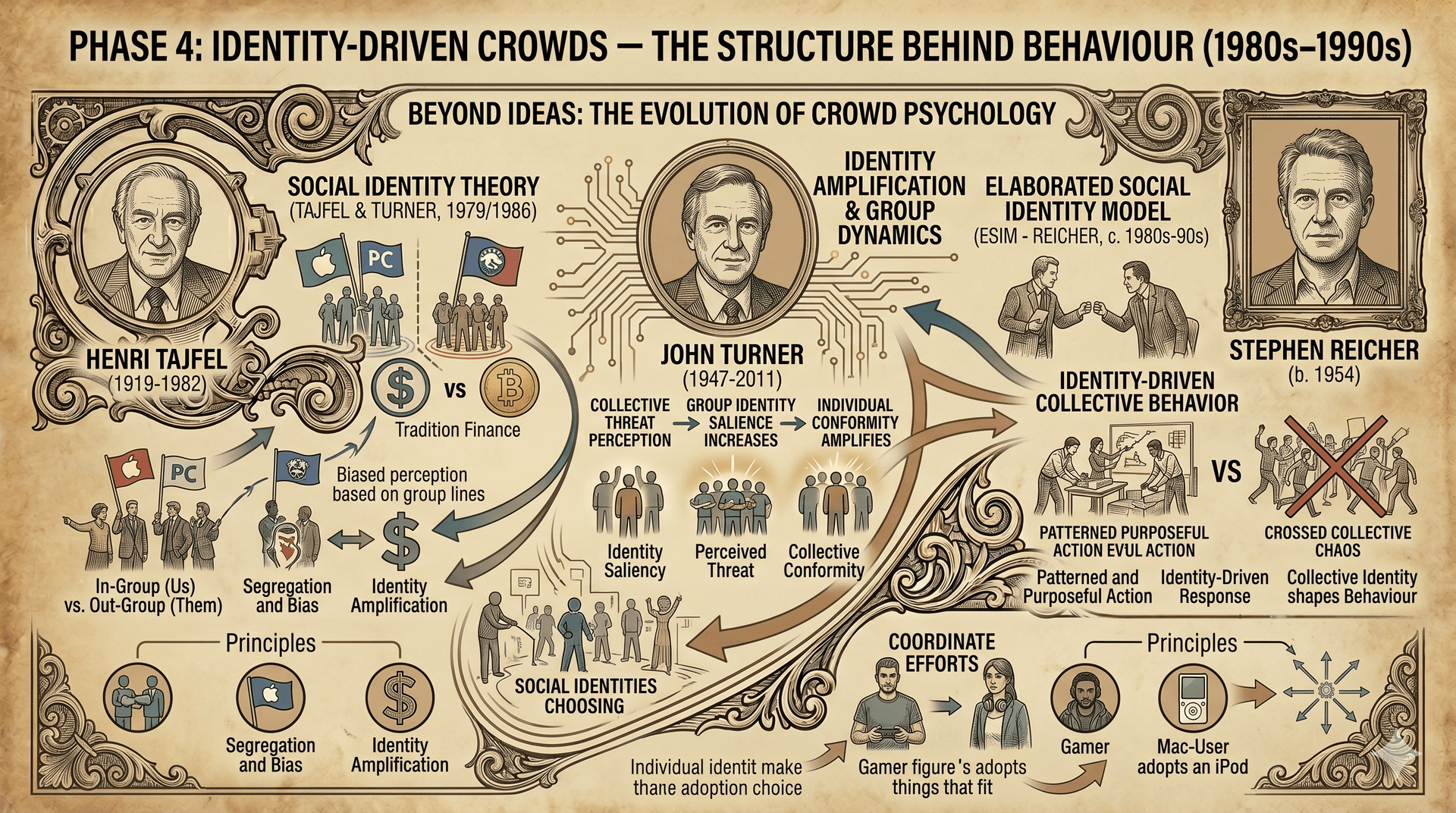
Phase 4: Identity-Driven Crowds — The Structure Behind Behaviour (1980s–1990s)
Later work by Henri Tajfel, John Turner, and Stephen Reicher changed the narrative entirely.
Crowds were not irrational.
They were identity-driven systems.
People adopt ideas to signal:
- who they belong to
- what they stand for
- what they reject
Implication for leaders:
Adoption is not just behaviour.
It is identity alignment.
Innovation must answer:
Who does this make me?
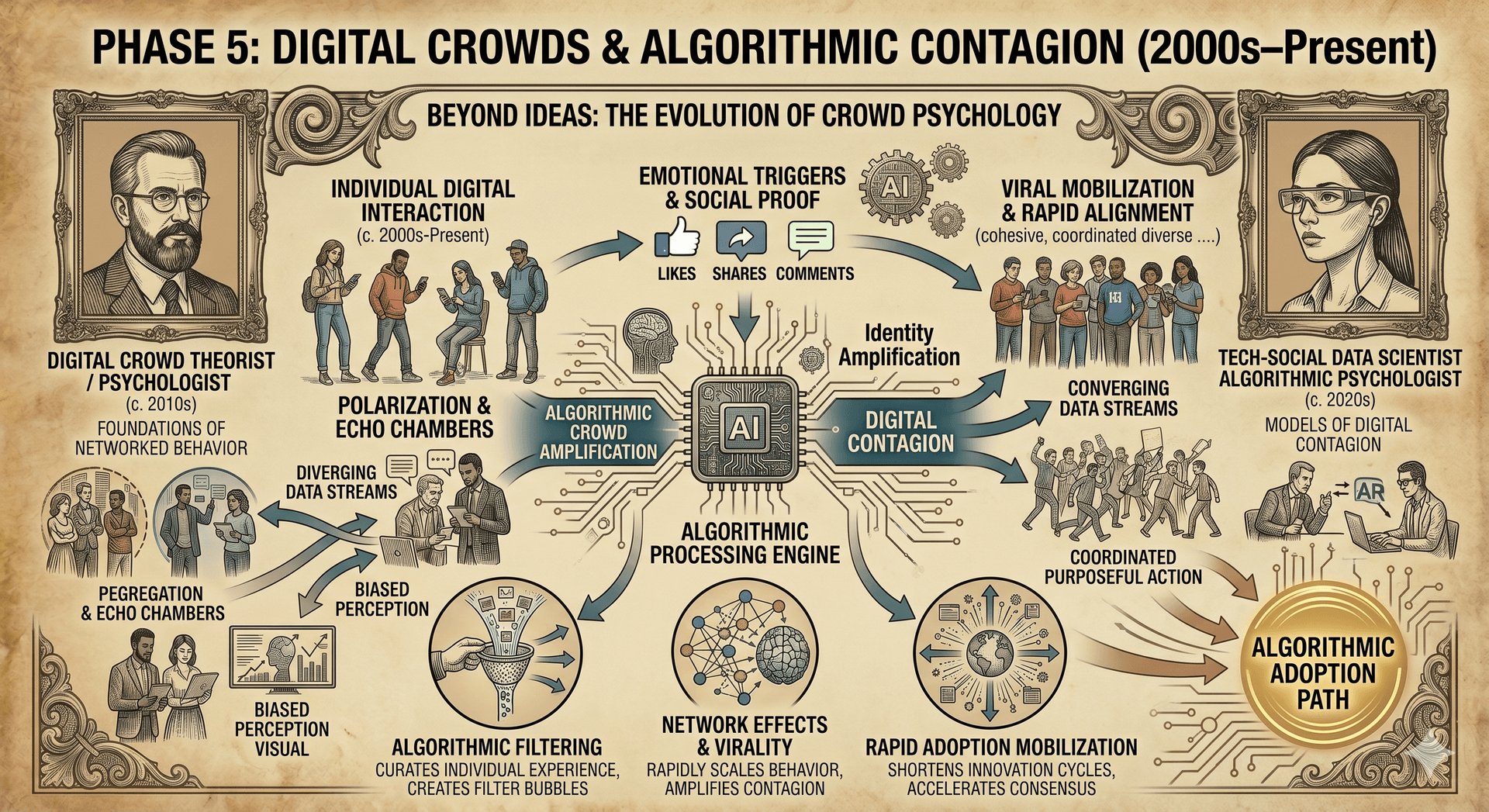
Phase 5: Digital Crowds & Algorithmic Contagion (2000s–Present)
Today, crowd psychology has been amplified by technology.
Social platforms have removed friction from:
- communication
- validation
- influence
The result:
- ideas spread instantly
- communities form rapidly
- trust accelerates, or collapses - quickly
Thinkers like Cass Sunstein and Jonah Berger highlight:
- echo chambers amplify belief systems
- social currency drives sharing
- triggers sustain momentum
Implication for leaders:
Innovation now operates in networked environments, not controlled channels.
Adoption is no longer linear.
It is exponential and volatile.
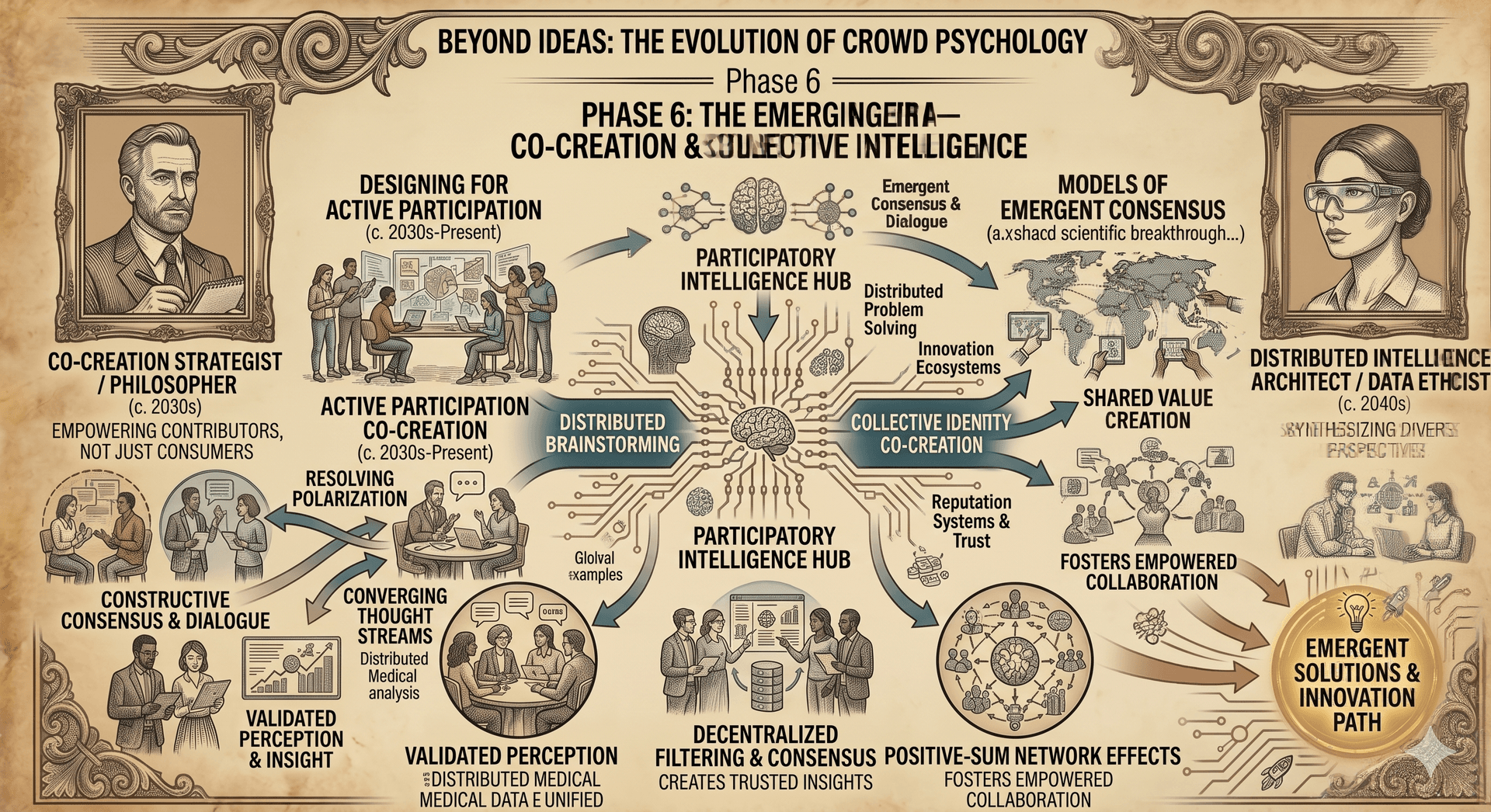
Phase 6: The Emerging Era — Co-Creation & Collective Intelligence
We are now entering a new phase:
The crowd is no longer just adopting innovation.
It is shaping it.
This is defined by:
- AI-amplified influence
- decentralized communities
- participatory ecosystems
- trust as a primary currency
The future is not:
> company → product → customer
It is:
> ecosystem → collaboration → co-creation
Implication for leaders:
You are no longer designing for users.
You are designing with communities.
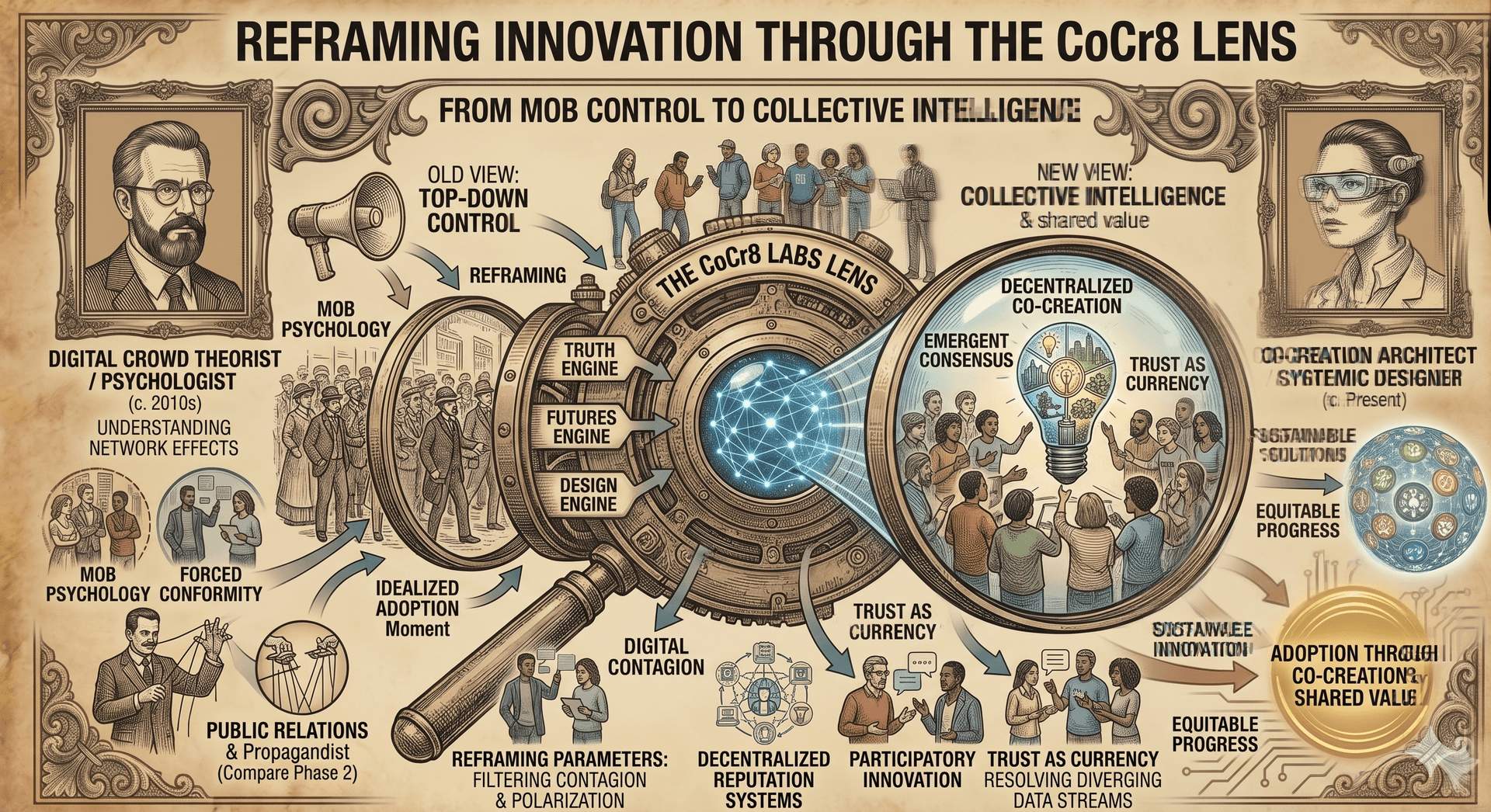
Reframing Innovation Through the CoCr8 Lens
When viewed through this historical progression, your framework becomes even more powerful:
Truth Engine
Prevents blind conformity and flawed assumptions.
Futures Engine
Anticipates shifts in identity, behaviour, and collective dynamics.
- Design Engine
Builds solutions that generate meaning, usability, and social currency.
(Emerging) Adoption Layer
Leverages:
- imitation (Tarde)
- influence (Bernays)
- social proof (Asch)
- identity (Tajfel)
- networks (modern platforms)
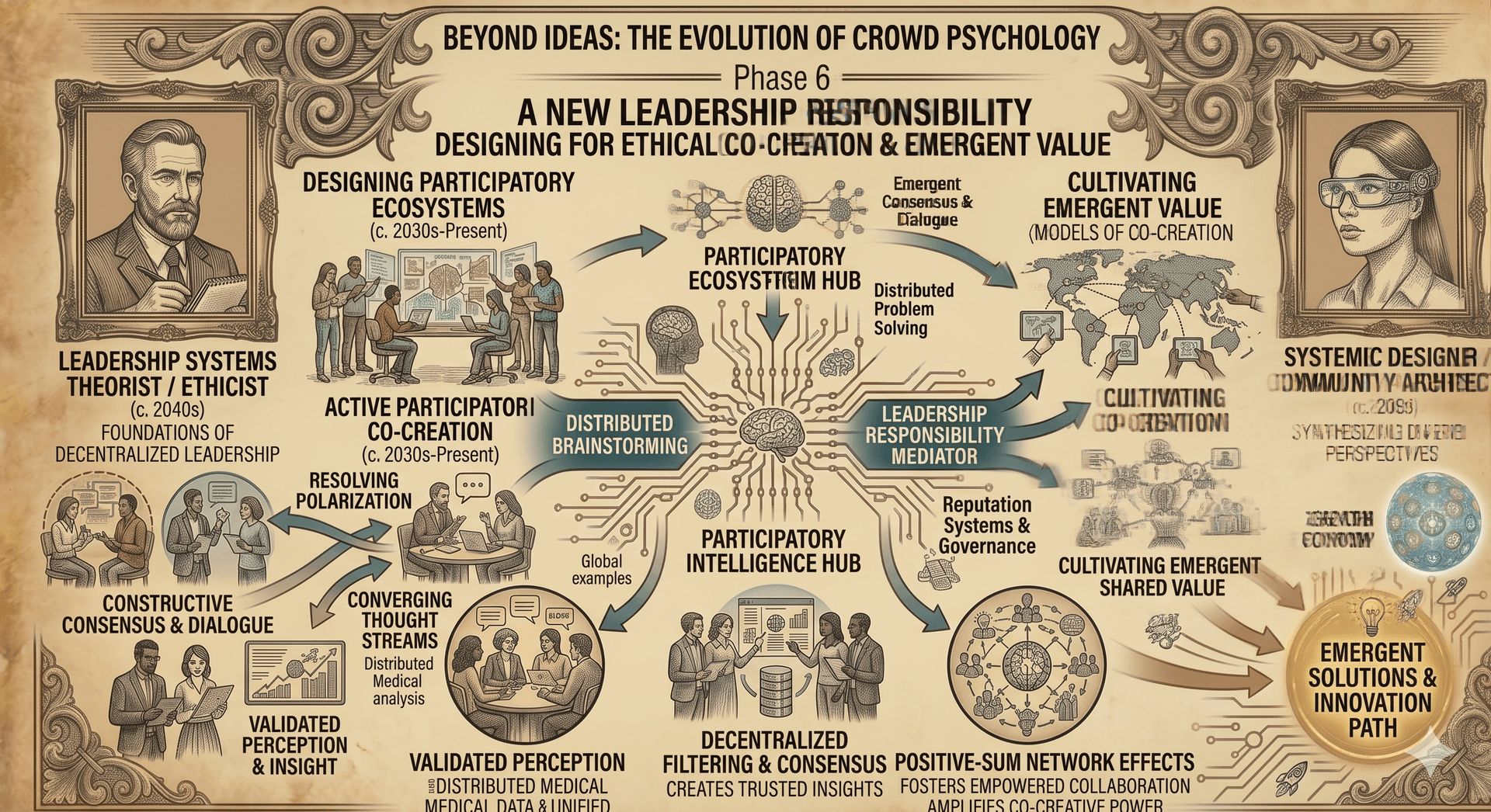
A New Leadership Responsibility
The history of crowd psychology reveals something critical:
The same forces that drive adoption…
can also drive misinformation, division, and manipulation.
Which means leadership now carries a new responsibility:
>Not just to innovate
>But to influence responsibly
The question is no longer:
“How do we get people to adopt this?”
It becomes:
“How do we design adoption that creates positive, sustainable impact?”
Innovation Is Not Built. It Is Carried.
Innovation is often framed as creation, but history tells us something different.
Innovation is not just built.
It is carried through people, through networks, through belief systems.
The crowd is not the final step in innovation.
It is the force that determines whether innovation lives or dies, and the leaders who understand this…won’t just create better ideas.
They will create ideas that move through the world with purpose.
If this thinking resonates, the CoCr8 OS is the framework behind it — available as a live decision tool, a consulting engagement, or a free starting point.
Try the Decision Spark Canvas, explore the CoCr8 Innovation Hub, or start a conversation.