Beyond Frameworks: Why the CoCr8 Labs 3D Operating System Exists — And Why Organizations Need It Now


There are moments in your career when you realize the problem was never a lack of ideas.
The whiteboards were full.
The workshops were inspiring.
The teams were talented and genuinely committed to change.
And yet… very little actually changed.
For years, I watched organizations gather around innovation as if it were an event rather than a capability. Leaders invested in transformation initiatives, innovation labs, and strategy sessions, all with the best intentions, but too often the outcomes felt disconnected from the energy that created them.
It wasn’t a failure of intelligence or ambition.
It was a failure of integration.
That realization became the starting point for what would eventually evolve into the CoCr8 Labs 3D Operating System, not as another framework to admire, but as a way to help organizations move from thinking to making.

The Origins of the Thinking
The CoCr8 Labs 3D Operating System did not begin as a framework.
It began as a question.
Why do intelligent, experienced organizations, filled with capable people, struggle to translate thinking into action?
Over years of working across industries and organizational contexts, a pattern appeared. Innovation and transformation efforts often lived in isolation:
- Strategy operated separately from execution.
- Future-focused conversations were disconnected from present realities.
- Human adoption was treated as an afterthought rather than a central design principle.
Organizations were not lacking ideas. They were lacking integration.
At the same time, many leaders were unknowingly engaging in innovation theatre, activities that looked innovative but failed to create lasting value.
It became clear that a different approach was needed. Not another model to admire, but an operating system designed to help organizations move.
Why “3D”?
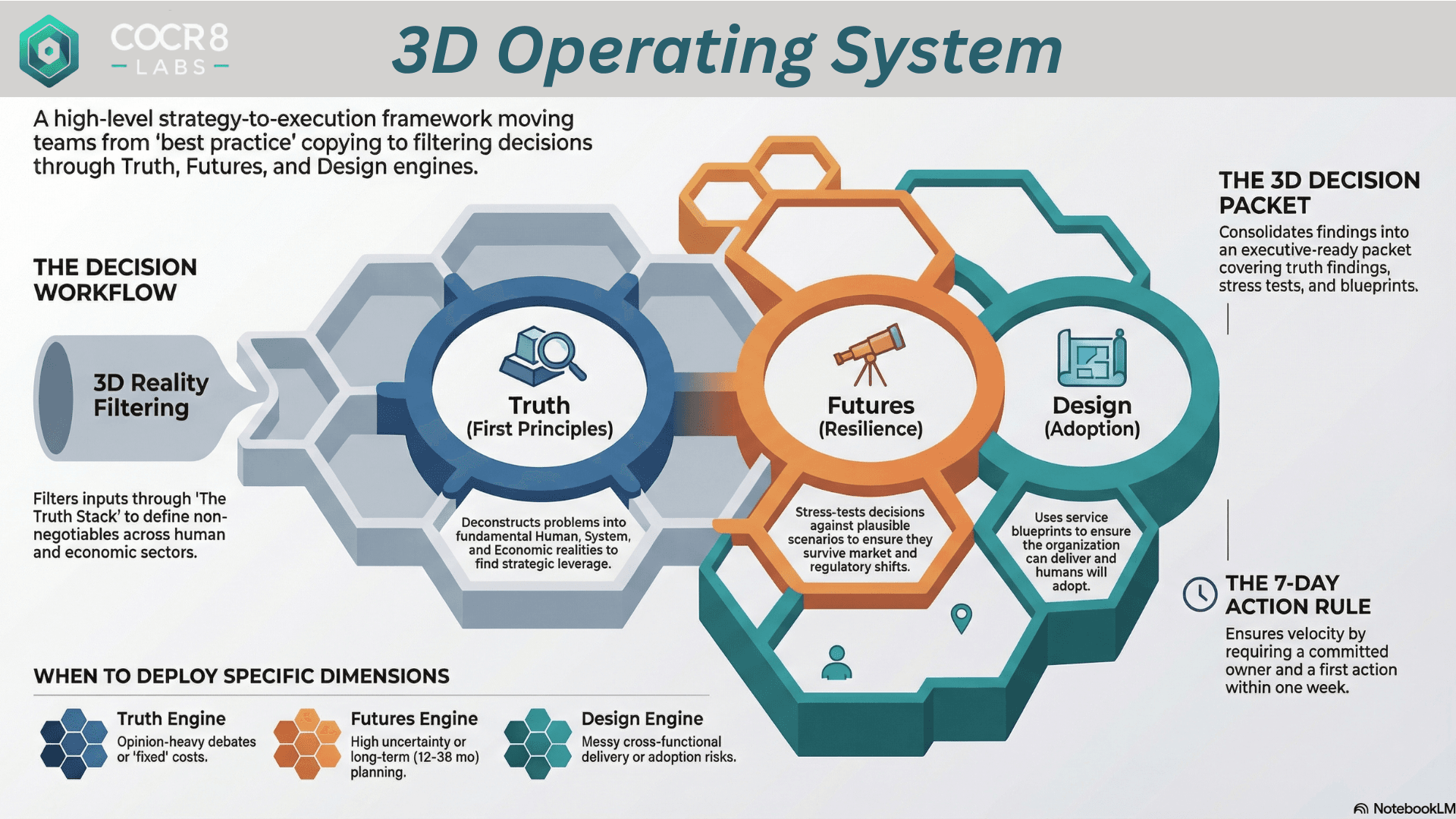
The CoCr8 Labs 3D Operating System is built on three interconnected engines:
Truth Engine (First Principles): Innovation begins by understanding what is actually real, not what we assume is real. This requires stripping away legacy assumptions, industry myths, and internal biases to rediscover the fundamental truths shaping a challenge or opportunity.
First principles thinking creates clarity. And clarity reduces wasted motion.
Futures Engine (Resilience): Organizations cannot predict the future with certainty, but they can prepare for multiple futures. Inspired by foresight methodologies and ecosystem thinking, this engine helps leaders navigate the spectrum from fads to megatrends, building resilience rather than reaction.
Futures thinking expands possibility without losing grounding.
Design Engine (Adoption): Innovation is not invention. Innovation is adoption.
Ideas create value only when they are embraced by people, customers, employees, partners, and communities. The Design Engine ensures solutions are human-centred, experiential, and capable of integration into real-world behaviours and systems.
Adoption is where innovation becomes real.
Together, these three dimensions form a system designed to move organizations beyond fragmented thinking into aligned action.

Why This Approach Matters Now
The timing for this shift is not accidental. Organizations today operate in conditions fundamentally different from even a decade ago:
- Technological acceleration is compressing product and service lifecycles.
- Markets are more interconnected, shaped by ecosystems rather than isolated competitors.
- Stakeholders expect meaningful outcomes, not just strategic intent.
Traditional linear models struggle in this environment because they separate thinking from doing. Strategy becomes theoretical. Innovation becomes symbolic. Change becomes slow. What is required now is an integrated operating model, one that connects:
Reality → Possibility → Adoption
Without this integration, organizations risk expending enormous energy without meaningful progress.
The Philosophy Behind the System
At the heart of the 3D Operating System lies a deeper philosophy, the belief that transformation is collaborative, not personal.
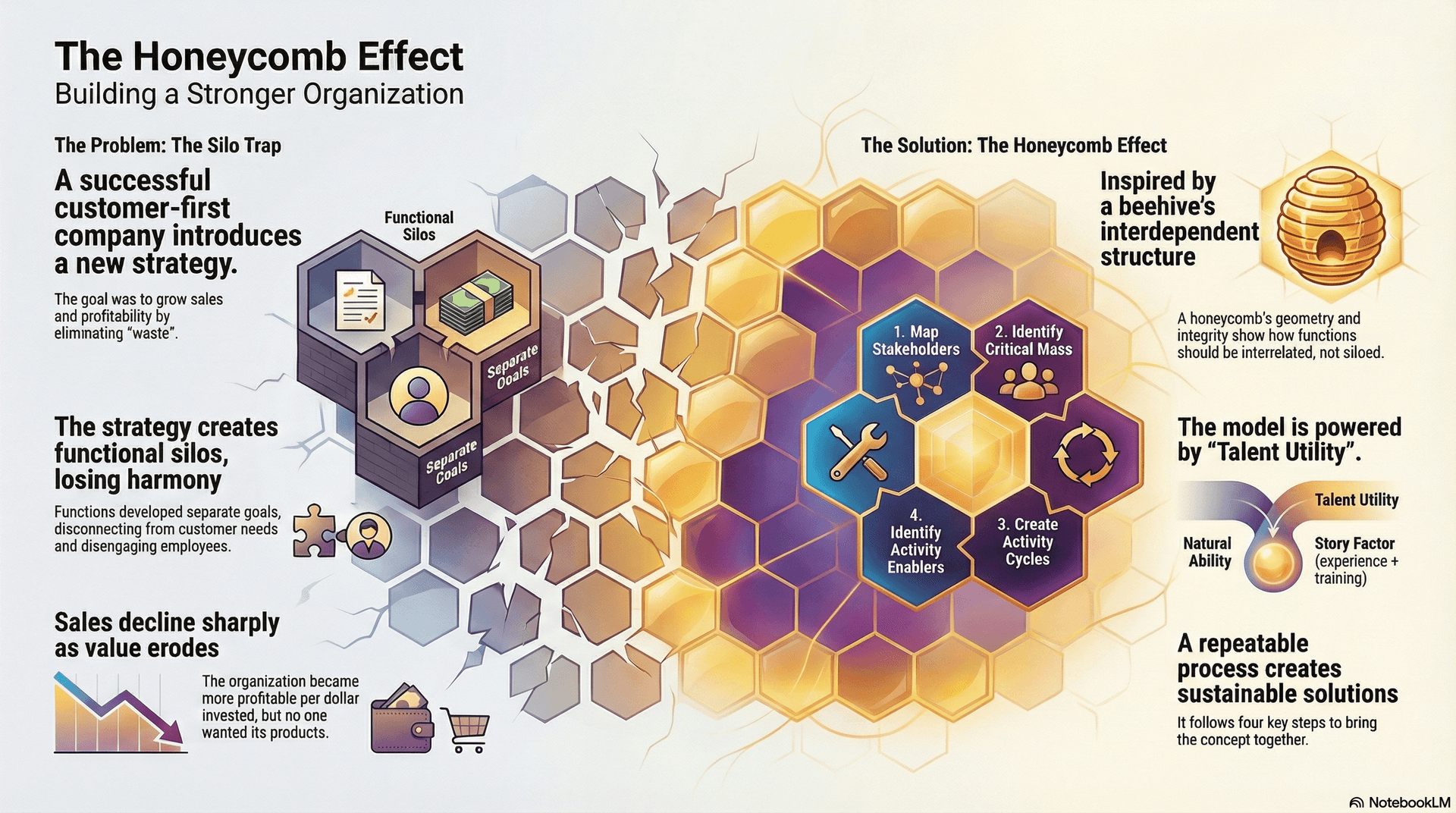
This thinking aligns with what I often refer to as the Honeycomb Effect: value emerges not from isolated brilliance but from interconnected ecosystems working toward shared outcomes.
Innovation is not a solitary act. It is a collaborative process shaped by relationships, context, and collective effort. Organizations that embrace this mindset move beyond internal silos and begin co-creating value with customers, partners, and broader industry stakeholders.
From Insight to Action
Perhaps the most important principle within the system is simple:
Insight must become action quickly.
Many innovation efforts fail not because of poor thinking, but because of hesitation. Ideas linger too long in conceptual space without entering real-world testing and learning.
The 3D Operating System encourages organizations to act their way into new thinking, to test, learn, and evolve through disciplined experimentation.
Progress becomes iterative rather than hypothetical.

Closing Reflection: Making Ideas Real
Frameworks alone do not transform organizations.
People do.
Systems that enable people to move from clarity to possibility to adoption are what allow innovation to transcend theatre and become meaningful change.
The CoCr8 Labs 3D Operating System is not intended as a perfect answer. It is a structured invitation, a way to help organizations align truth, future readiness, and human-centred design into a cohesive path forward.
Because in today’s environment, the question is no longer:
“How do we appear innovative?”
It is:
What are we willing to make real — together?
If this thinking resonates, the CoCr8 OS is the framework behind it — available as a live decision tool, a consulting engagement, or a free starting point.
Try the Decision Spark Canvas, explore the CoCr8 Innovation Hub, or start a conversation.