The Three Engines of Modern Innovation: How First Principles Thinking, Futures Thinking, and Design Thinking Work Together to Shape the Future


In every era, a small group of organizations consistently redefine industries.
They do not merely improve existing products. They do not simply follow trends.
Instead, they rethink reality, anticipate change, and design better experiences for people.
Companies like Tesla, Amazon, Toyota, Apple, Airbnb, and IKEA have built extraordinary growth by mastering three complementary capabilities:
- First Principles Thinking
- Futures Thinking
- Design Thinking
Individually, each discipline is powerful. Together, they form a complete innovation system, one that allows organizations to move beyond incremental improvement and create entirely new possibilities.
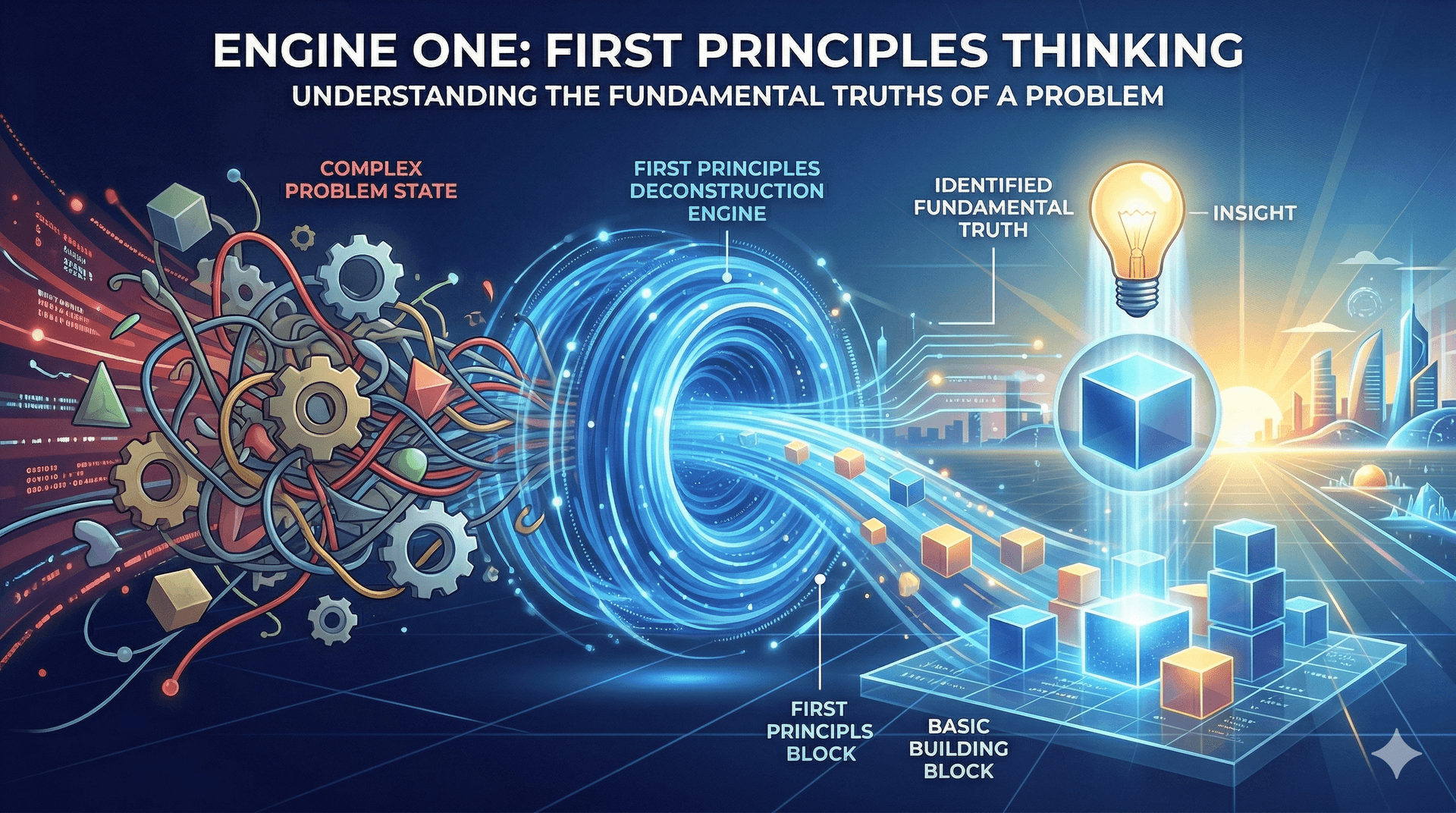
Engine One: First Principles Thinking
Understanding the Fundamental Truths of a Problem
First principles thinking originates in the philosophy of Aristotle, who described them as the foundational truths from which knowledge is derived.
Rather than solving problems by copying existing solutions, first principles thinkers ask:
What do we know to be fundamentally true?
Then they rebuild solutions from the ground up.
Example: Tesla
Tesla famously applied first principles thinking to electric vehicles.
The prevailing assumption was that EVs would always be expensive and niche. Instead of accepting that assumption, Tesla broke the problem down into its core components:
- battery cost
- manufacturing processes
- energy density
- supply chains
By redesigning these elements from the ground up, most notably through Gigafactories and vertical integration, Tesla dramatically reduced battery costs and transformed the economics of electric vehicles.
What began as a challenge to industry assumptions ultimately helped reshape the automotive sector.
What First-Principles Organizations Do Differently
Organizations that consistently embrace first principles thinking:
- Challenge inherited industry assumptions
- Break complex systems into fundamental components
- Focus on root causes rather than symptoms
- Rebuild systems around core truths
Companies like Toyota applied this mindset when developing lean manufacturing, while Amazon used it to redesign retail logistics around what customers fundamentally value: lower prices, greater selection, and faster delivery.
The result is often breakthrough innovation rather than incremental change.
Engine Two: Futures Thinking
Anticipating Change Before It Happens
While first principles thinking helps organizations understand reality, futures thinking helps them explore possibilities.
Rather than predicting the future, futures thinking examines signals of change, emerging trends, and alternative scenarios to help organizations prepare for multiple potential outcomes.
It shifts strategy from reactive planning to proactive exploration.
Example: Shell
One of the most famous examples of futures thinking comes from Shell’s scenario planning work.
In the early 1970s, Shell developed scenarios exploring potential geopolitical disruptions in oil supply. When the global oil crisis occurred, Shell was far better prepared than many competitors.
Since then, the company has continued using scenarios to explore the future of energy systems, climate policy, and global demand.
What Futures-Oriented Organizations Do Differently
Organizations that integrate futures thinking typically:
- Scan continuously for weak signals and emerging trends
- Develop multiple future scenarios rather than a single forecast
- Explore long-term technological, cultural, and economic shifts
- Translate foresight into strategic investments
For example:
- Siemens analyzes emerging technologies such as industrial AI and robotics
- LEGO studies the future of play and learning
- Mastercard tracks signals shaping the future of payments
The advantage of futures thinking is simple:
It allows organizations to identify opportunities years before competitors recognize them.
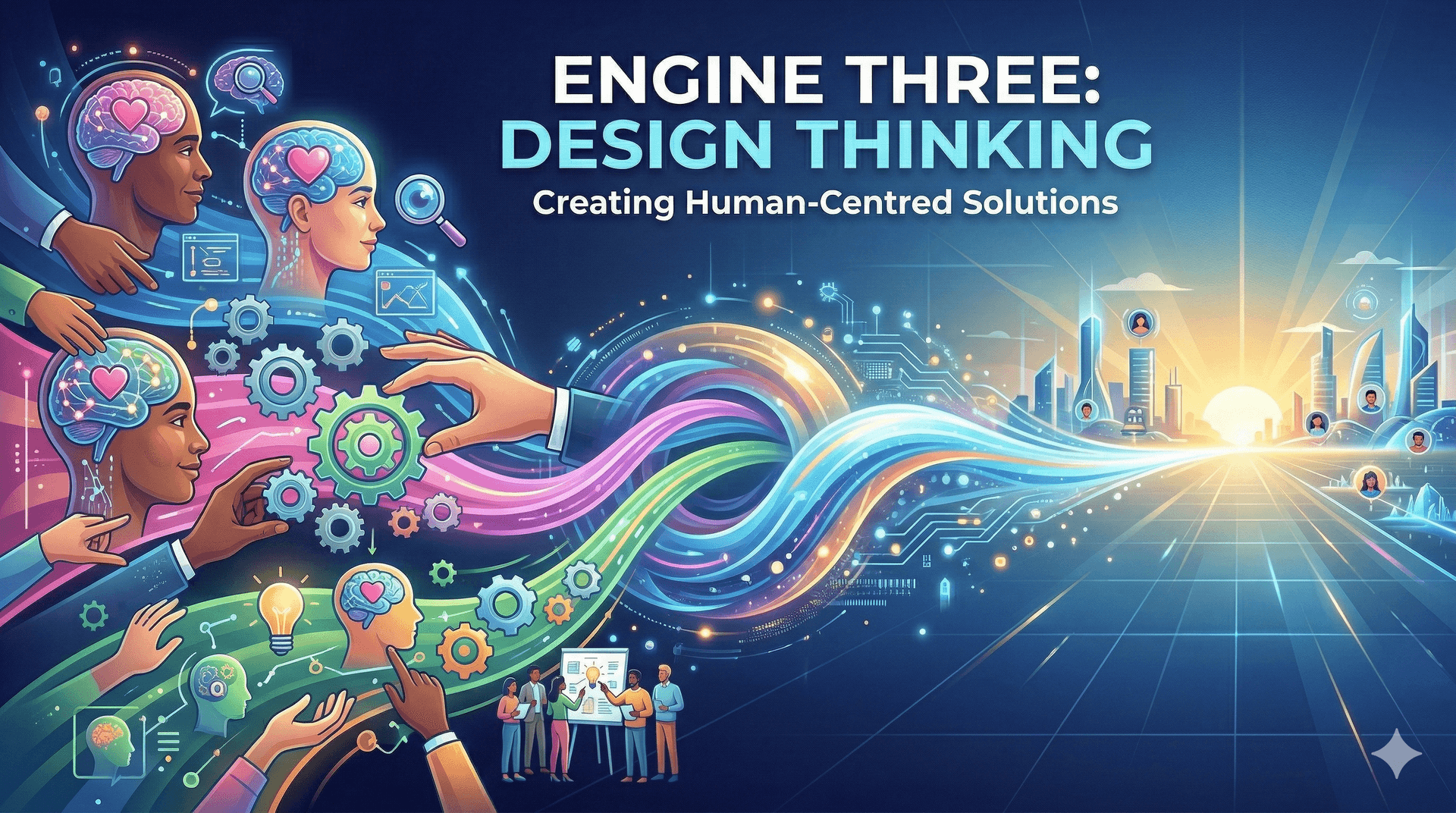
Engine Three: Design Thinking
Creating Human-Centred Solutions
While first-principles thinking clarifies reality, futures thinking explores possibilities, and design thinking ensures innovation actually works for people.
Design thinking begins with empathy.
Instead of starting with technology or internal assumptions, organizations start by understanding human needs, behaviours, and experiences.
Service design expands this perspective further by examining the entire ecosystem that delivers value, including:
- products
- digital platforms
- physical environments
- operational systems
- employee interactions
Example: Airbnb
Airbnb is one of the clearest examples of design thinking in action.
The founders approached hospitality through the lens of design. They studied how guests and hosts interacted and identified trust as the central challenge.
By designing systems around identity verification, ratings, and community trust, Airbnb unlocked a new model of hospitality.
What began as a simple concept, renting spare rooms, became a global platform that transformed travel.
What Design-Led Organizations Do Differently
Organizations that apply design thinking consistently:
- Start with deep human insight and empathy
- Map entire customer journeys rather than isolated touchpoints
- Prototype and test ideas rapidly
- Bring cross-functional teams together to solve problems
Companies like Apple, Nike, Starbucks, and Intuit have used design thinking to create products and services that people not only use but also love.
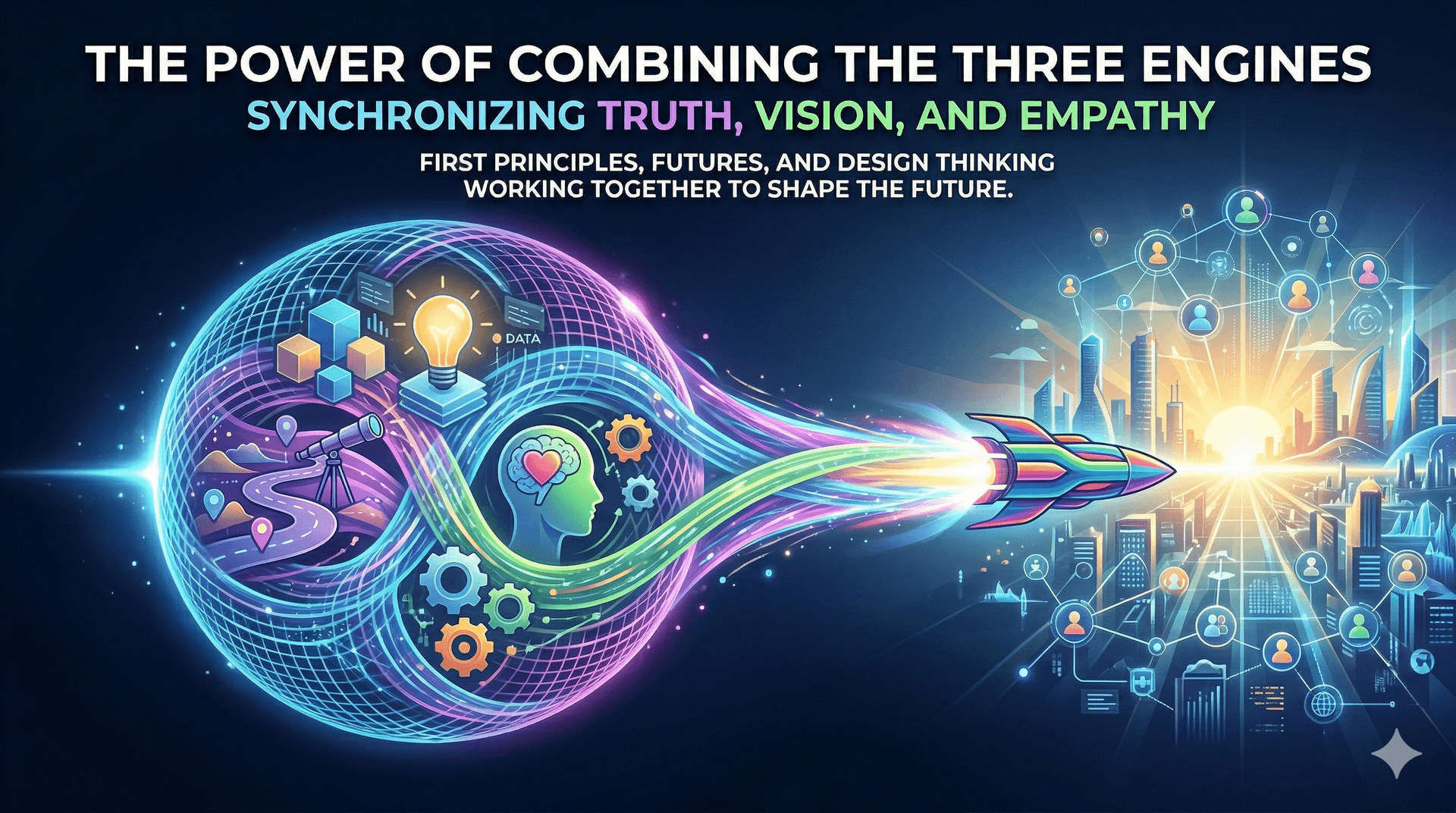
The Power of Combining the Three Engines
Each of these disciplines is powerful on its own.
But the real advantage emerges when they are used together.
First Principles Thinking
Reveals what is fundamentally true
Futures Thinking
Explores what might become true
Design Thinking
Builds solutions people will adopt
Together, they create a continuous innovation engine:
- Understand the core problem
- Explore emerging opportunities
- Design solutions for real people
- Test, learn, and iterate
This integrated approach enables organizations to move from insight to innovation with far greater clarity and confidence.
The Organizations Leading the Future
When we look across industries, the companies that consistently shape the future share a common pattern.
They challenge assumptions like Tesla.
They anticipate change like Shell.
They design experiences like Airbnb.
In other words, they combine first principles thinking, futures thinking, and design thinking into a unified approach to innovation.
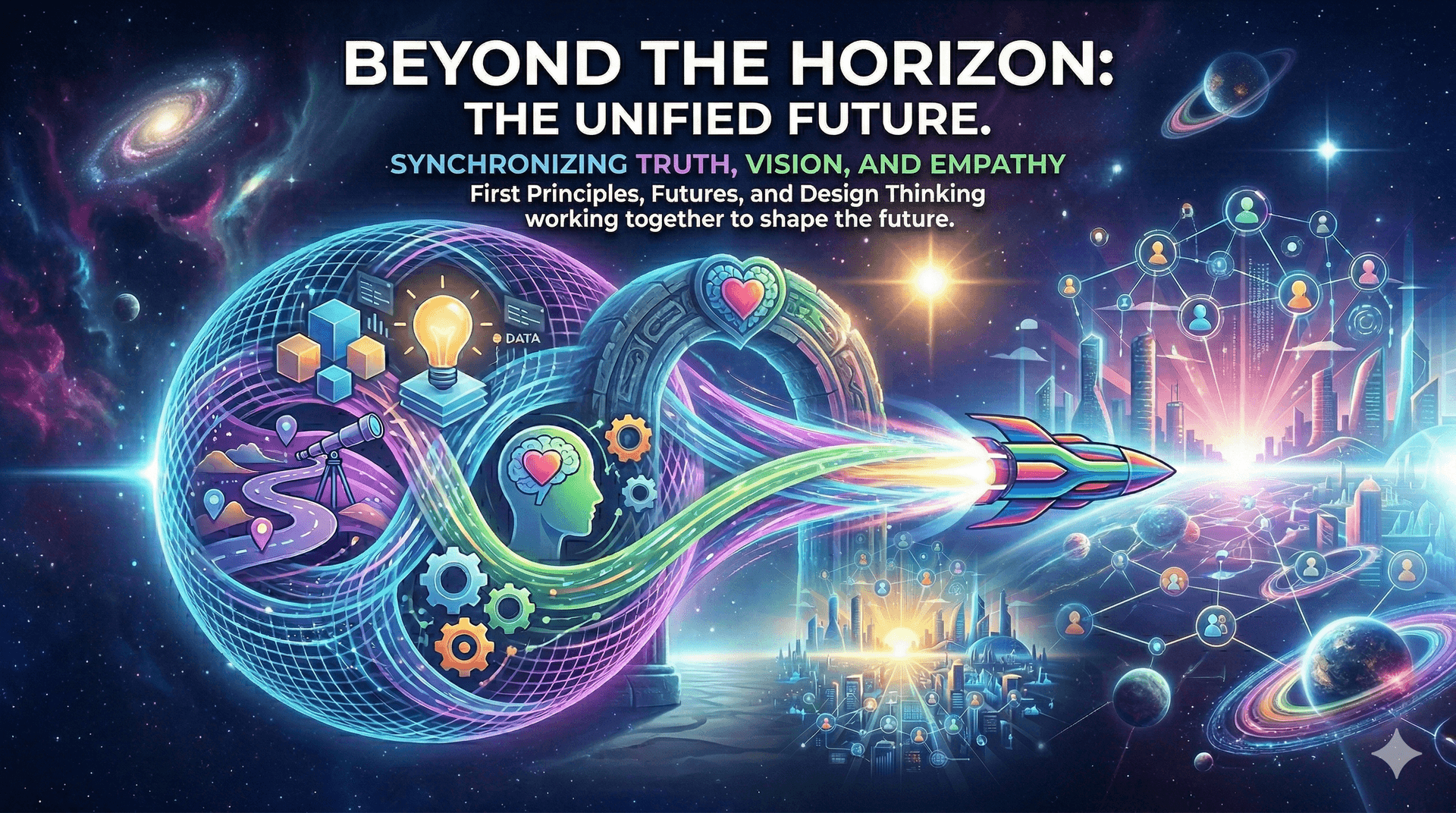
Beyond the Horizon
The future belongs to organizations that can understand reality, anticipate change, and design solutions for people.
First-principles thinking reveals the truth about a problem.
Futures thinking reveals the direction of change.
Design thinking transforms insight into human-centred innovation.
Together, these three engines provide a powerful framework for building the organizations and the industries of tomorrow.
The question for leaders is no longer simply:
How do we innovate?
But rather:
Which of these engines are we using to shape the future?