The Master Pattern: How Crowd Psychology Shapes Marketing Movements and Failures


Why Some Brands Become Movements — And Others Become Case Studies
Innovation, marketing, branding, and experience design often focus on one central question:
How do we get people to care?
But history suggests that is the wrong question. The real question is:
How do people decide what belongs to them?
Across decades of marketing evolution, one truth becomes increasingly clear:
Brands do not succeed because they communicate effectively.
They succeed because they align with identity, and identity does not live inside an individual.
It lives inside the crowd.
The image on the LinkedIn post, Crowd Psychology Master Pattern timeline, reveals a powerful historical reality:
Marketing has never simply been about persuasion.
It has always been about collective behaviour.
From the rise of mass advertising in the 1950s to the algorithmic amplification of today, the same psychological mechanisms recur across generations.
What changes is not the crowd. What changes is the medium.
The Crowd Is Not an Audience
Traditional marketing often assumes people make decisions independently. Research across psychology, sociology, and behavioural science tells a different story.
Humans are social adopters. We decide what matters by observing:
- what others validate
- what signals belonging
- what aligns with identity
- what gains momentum
This is why crowd psychology matters. Not because crowds are irrational, but because crowds are systems. They create meaning, and brands either become part of that meaning…or become rejected by it.
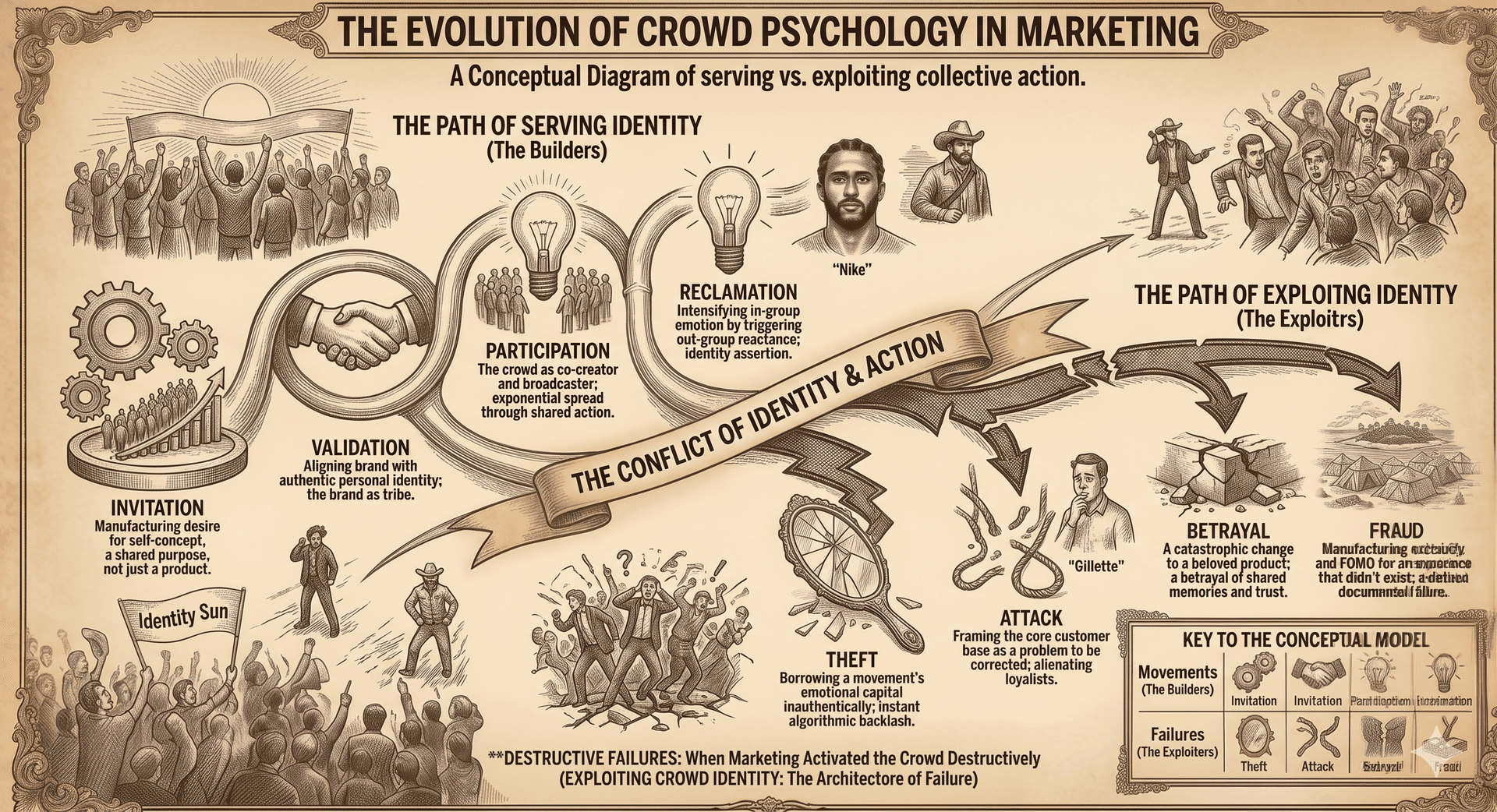
The Evolution of Crowd Psychology in Marketing
The Master Pattern reveals three major eras that shaped how organizations influence collective behaviour.
Era One: Engineered Consent (1950s–1980s)
The mid-20th century marked the rise of modern advertising. This was the age of mass persuasion. Influenced by thinkers such as Sigmund Freud and Edward Bernays, brands learned that products did not need to be sold solely on utility. They could be sold through symbolism. This period gave rise to campaigns that transformed products into identity markers.
Example: Marlboro Man
The Marlboro campaign did not sell cigarettes.
It sold rugged masculinity.
Freedom.
The American frontier.
Consumers adopted the identity attached to the product.
The cigarette became secondary.
Example: Harley-Davidson
Harley did not create customers.
It created a tribe.
Riders joined a lifestyle.
The motorcycle became a visible badge of belonging.
Example: Apple 1984
Apple positioned itself as a rebellion against conformity.
IBM represented control.
Apple represented liberation.
The campaign established an in-group and an out-group.
The crowd was no longer buying a computer.
They were joining a movement.
Era Two: Authenticity & Participation (1990s–2010s)
The internet shifted power. Brands could no longer speak to audiences. People wanted to participate.
This era introduced a major transition:
From engineered persuasion → to shared identity.
Example: Apple Think Different
Apple removed products entirely.
Instead, the campaign celebrated rebels, creators, and visionaries.
It invited consumers into a belief system.
This was not marketing.
It was identity invitation.
Example: Patagonia — “Don’t Buy This Jacket”
Patagonia aligned with environmental values.
Its anti-consumption message paradoxically increased loyalty.
The crowd rewarded perceived authenticity.
Example: ALS Ice Bucket Challenge
This campaign succeeded because the crowd became the creator.
Participation itself became the message.
The movement spread because every participant amplified it.
The audience became the medium.
Era Three: Algorithmic Acceleration & Social Purpose (2010s–Present)
Today, crowd psychology operates at unprecedented speed. Digital networks compress adoption timelines. Ideas move instantly. Validation happens publicly, and backlash travels faster than approval. This era is defined by algorithmic amplification. The crowd is no longer passive.
It is reactive, and brands must understand how identity operates inside polarized environments.
Example: Nike & Colin Kaepernick
Nike intentionally polarized.
The campaign alienated one audience.
But deepened loyalty with another.
The result:
Stock dipped temporarily.
Then surged significantly.
Nike understood that modern identity is not neutral.
It is tribal.
Example: Spotify Wrapped
Spotify transformed listening behavior into public identity.
Users shared their personal music data because it reflected who they believed they were.
The crowd became the distribution engine.
Example: Share a Coke
Personalization transformed a commodity product into social content.
Consumers searched for names, shared photos, and created momentum.
The product became a social signal.
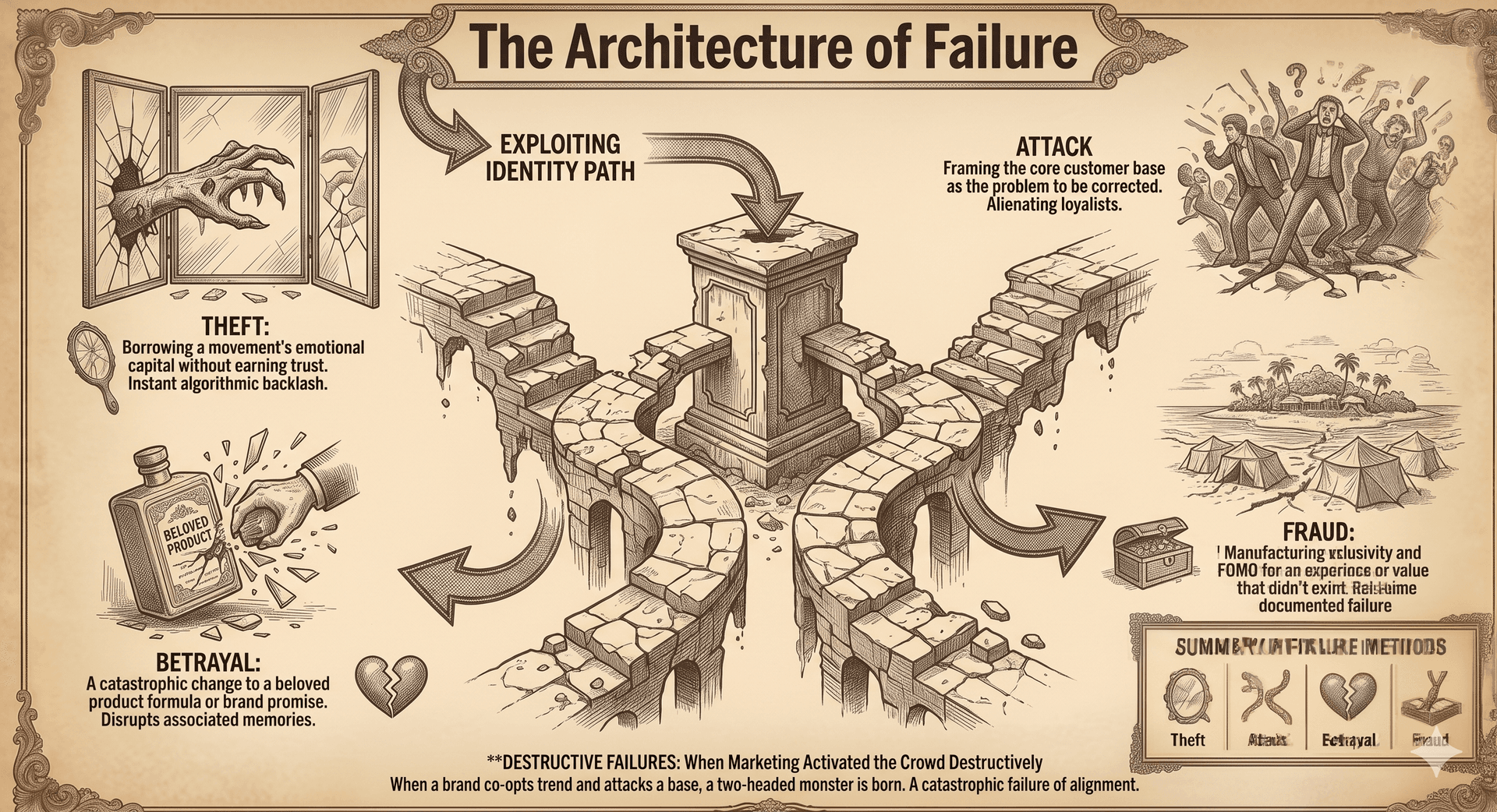
The Architecture of Failure
The same crowd dynamics that create movements can also destroy brands. The Master Pattern timeline highlights a powerful insight:
Marketing failures rarely result from bad execution. They happen because of identity misalignment. Across decades of examples, four failure archetypes emerge.
1. Identity Betrayal
When a brand changes something the crowd believes belongs to them.
Example: New Coke
Coca-Cola underestimated emotional attachment.
Consumers did not view Coke as a drink.
They viewed it as memory, ritual, and familiarity.
The backlash revealed something profound:
The crowd felt ownership.
2. Identity Theft
When a brand borrows cultural meaning without earning trust.
Example: Pepsi & Kendall Jenner
Pepsi attempted to insert itself into protest culture.
The crowd recognized the disconnect instantly.
The backlash was not about advertising.
It was about perceived inauthenticity.
3. Identity Attack
When a brand frames its own customer as the problem.
Example: Gillette “The Best Men Can Be”
The issue was not the cultural conversation.
The issue was how it was framed.
Consumers interpreted the message as an accusation rather than an invitation.
Crowd identity reacted defensively.
4. Identity Fraud
When expectation exceeds reality.
Example: Fyre Festival
The same social mechanisms that created demand also documented collapse.
Influencers amplified hype.
Consumers amplified failure.
The crowd became both the creator and destroyer of the experience.
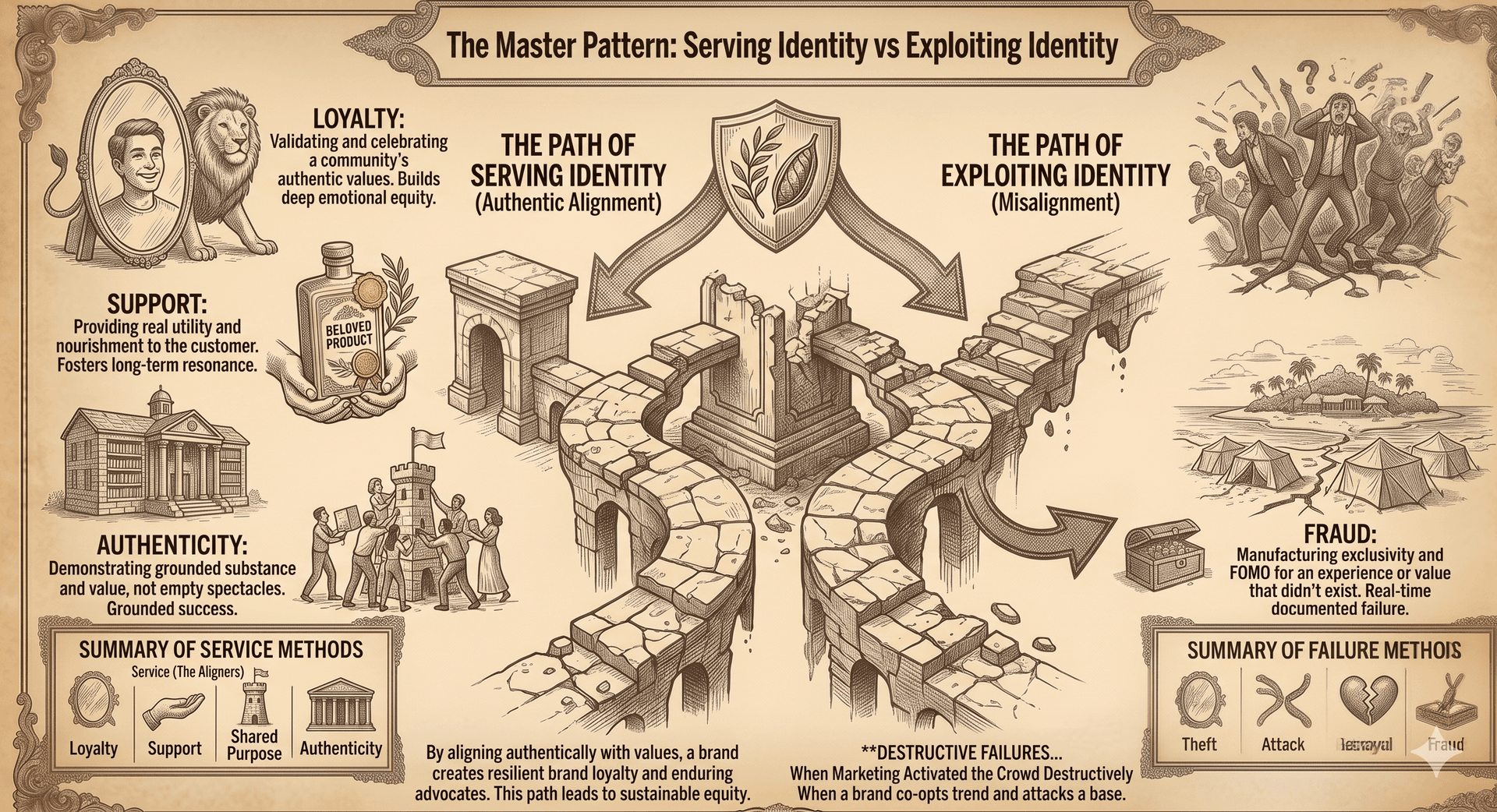
The Master Pattern: Serving Identity vs Exploiting Identity
When we examine every success and failure together, a single principle emerges:
Movements happen when brands serve identity.
Failures happen when brands exploit identity.
This distinction matters more today than ever.
Because the crowd is no longer simply listening.
It is interpreting.
Participating.
Judging.
Amplifying.
Rejecting.
And increasingly — organizing.
The Crowd Is a Living Identity System
The timeline ultimately reveals something deeper than marketing.
The crowd is not random.
It is patterned.
It behaves according to repeatable psychological principles.
Movements emerge when brands:
- validate identity
- invite belonging
- enable participation
- create shared meaning
Failures emerge when brands:
- manipulate identity
- misread cultural context
- borrow trust without earning it
- break the emotional contract with the crowd
This is why crowd psychology belongs inside modern innovation strategy. Innovation is not complete until something is built.
Innovation is complete when people adopt it.
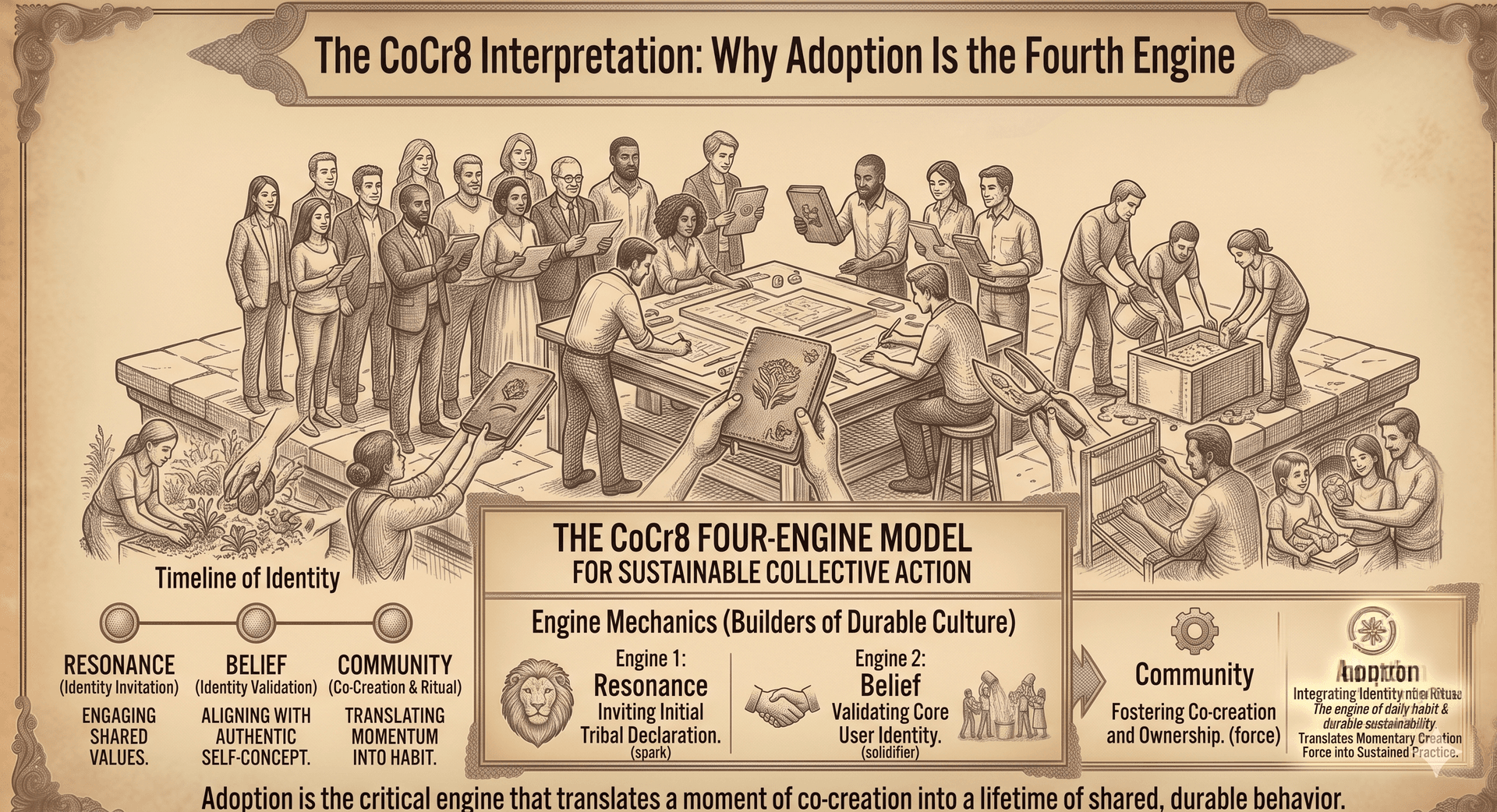
The CoCr8 Interpretation: Why Adoption Is the Fourth Engine
This is where the CoCr8 framework evolves.
For years, innovation has relied on three engines:
Truth Engine → understanding reality
Futures Engine → anticipating change
Design Engine → creating experiences
But crowd psychology reveals a missing layer.
Adoption Engine
The engine responsible for:
- social momentum
- collective belief
- identity alignment
- behavioral spread
Because the best idea does not always win.
The idea that fits identity — and moves through the crowd — does.
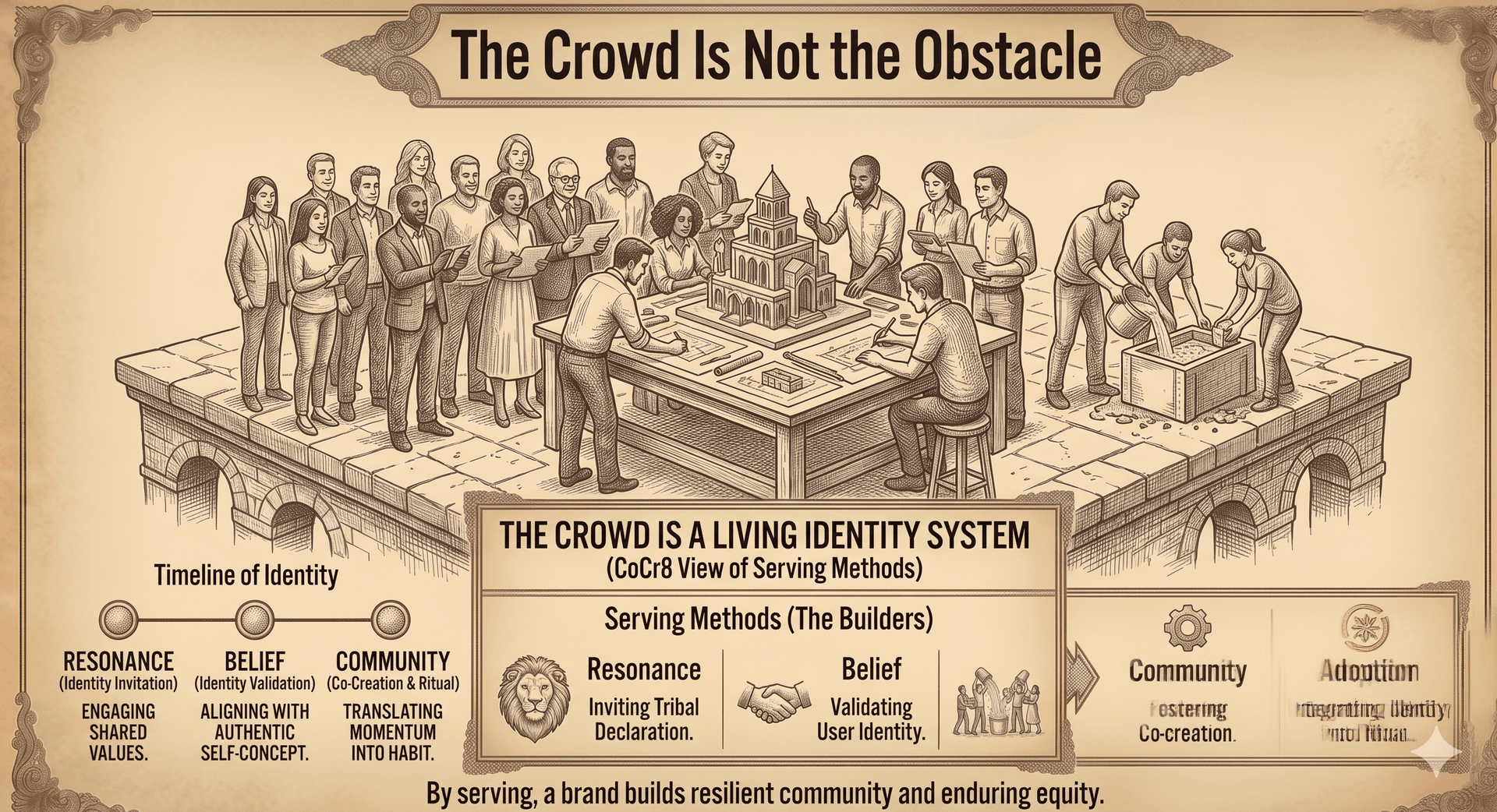
The Crowd Is Not the Obstacle
For decades, organizations have treated the crowd as a target.
A segment.
A demographic.
A consumer group.
But the crowd is not something to persuade.
It is something to understand.
The brands that shape the future are not simply better marketers.
They are better interpreters of human identity, and they recognize one essential truth:
The crowd is not the obstacle to innovation.
The crowd is the mechanism through which innovation survives.
Closing Question
When your organization launches something new…
Are you building a product?
Or are you building a movement?