Before Strategy Decks, There Was Aristotle: Why the Truth Engine Matters Now


We live in an age of acceleration.
Strategy decks are built overnight. Innovation labs launch with fanfare. Frameworks multiply faster than organizations can meaningfully absorb them.
And yet, clarity often feels further away than ever.
Before all of this, before methodologies, before transformation roadmaps, before disruption became a strategic objective, there was Aristotle.
He did not teach scale or speed. He taught foundations. In a world obsessed with motion, Aristotle asked a quieter and far more demanding question:
Not how do we change?
But:
What must be true?
This question sits at the heart of what I call the Truth Engine within the CoCr8 Labs 3D Operating System, and increasingly, it may be one of the most essential disciplines for modern leadership.

When Leadership Challenges Are Philosophical
Many organizational challenges appear operational. Teams restructure. Strategies evolve. Processes are optimized.
Yet beneath this activity often lies something deeper: unexamined assumptions guiding decision-making.
We improve execution without revisiting intent.
First principles thinking interrupts this pattern by dismantling inherited logic and forcing leaders to return to foundational reasoning. This is not philosophical abstraction; it is practical clarity. Aristotle understood that leadership does not begin with activity; it begins with understanding reality.

Virtue as Organizational Alignment
Aristotle framed virtue not as abstract morality but as practiced habit, courage, integrity, and justice cultivated through consistent action. Modern organizations often overlook this insight.
Leadership is not defined by hierarchy or personality. It emerges over time through behaviour aligned with purpose. When leaders ground decisions in core principles rather than reactive impulses, they create coherence, and coherence builds trust.
The Truth Engine begins here: not with declarations of values, but with alignment between belief and behaviour.

Practical Wisdom in Complex Environments
Aristotle’s concept of phronesis, or practical wisdom, describes the ability to make sound judgments amid uncertainty. Today, we might call this executive thinking, yet its essence remains unchanged:
Understand foundational values.
Evaluate long-term consequences.
Act in alignment with collective flourishing rather than short-term optics.
The Truth Engine operationalizes this discipline by asking leaders to interrogate their strategy:
Does this align with our purpose?
Does it create sustainable value?
Or is it reaction disguised as progress?
Clarity precedes courage.

Human Flourishing as Strategic North Star
At the center of Aristotle’s philosophy lies eudaimonia, human flourishing.
This shifts leadership away from transactional output toward meaningful progress. When organizations align strategy with human flourishing, for employees, customers, partners, and ecosystems, performance becomes a byproduct rather than an objective forced through pressure alone.
The Truth Engine re-centers organizations around this deeper inquiry, ensuring innovation remains anchored in purpose rather than novelty.

Balance Through First Principles
Aristotle’s golden mean reminds us that leadership lies between extremes.
Modern organizations frequently oscillate between over-innovation and stagnation, over-optimization and paralysis, bold vision and defensive conservatism.
First-principles thinking introduces balance by reconnecting decisions to their foundational intent. Balance is not compromise. It is alignment.
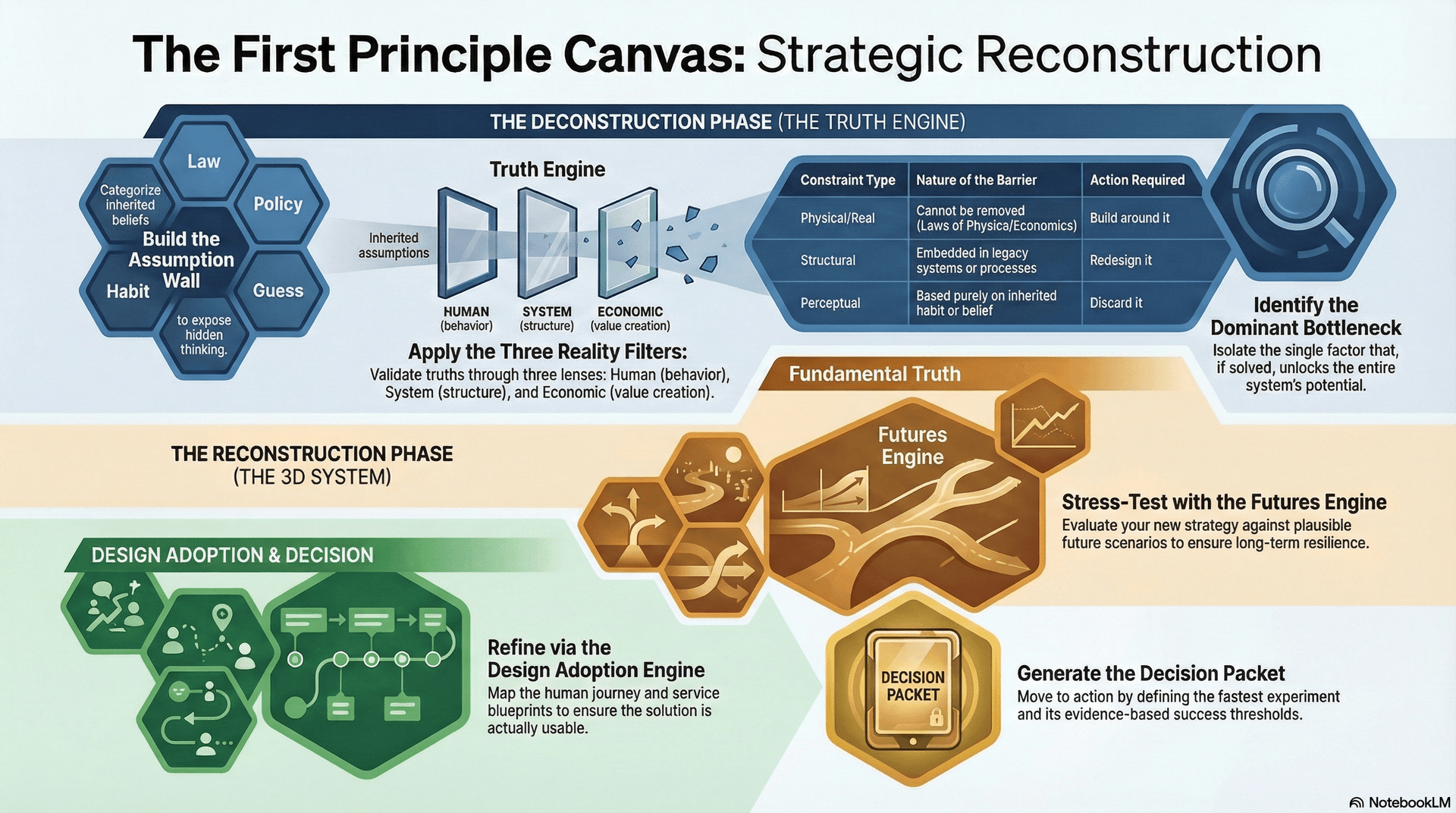
Why the Truth Engine Matters Now
We operate in dynamic times. Technology accelerates. Markets fragment. Ecosystems intertwine.
Inherited logic expires quickly under these conditions. Organizations that fail to revisit foundational assumptions risk building complexity on unstable ground.
The Truth Engine does not slow innovation.
It anchors it.
Without clarity:
Futures thinking becomes speculation.
Design becomes aesthetic.
Innovation becomes theatre.
Truth grounds the entire operating system.
Start With Truth
Aristotle did not leave us a business framework. He left us a way of thinking.
First-principles thinking is not ancient philosophy removed from modern leadership; it is intellectual clarity applied to current complexity.
Sometimes progress does not begin with acceleration. It begins with returning to fundamentals.
The real leadership question is not:
“How do we move faster?”
But:
What must be true — before we move at all?